An idea for OnpageSEO.com
An on-page audit or content-grading tool
Turn page observations into an editor-friendly queue of decisions, with evidence behind each suggestion.
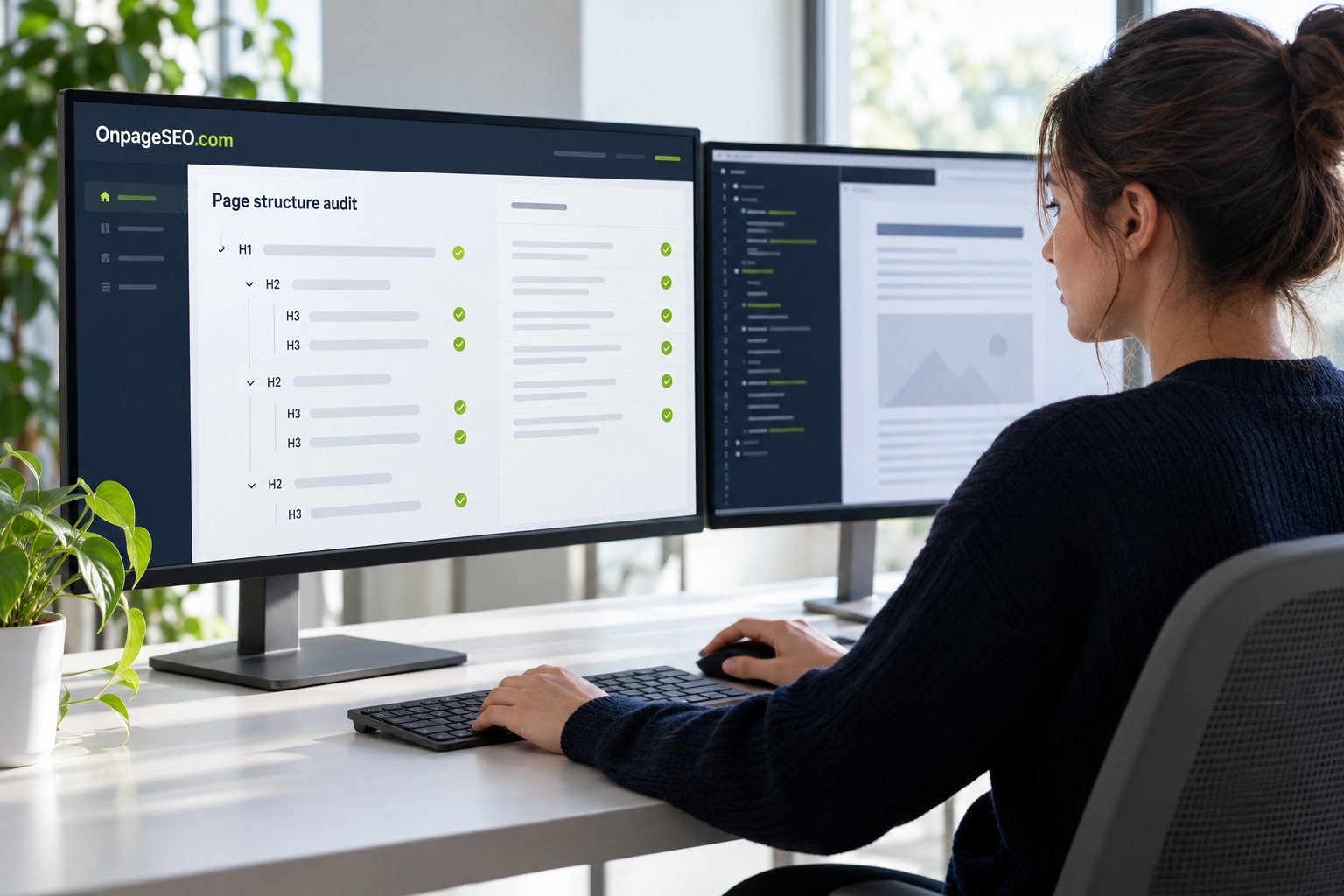
A page audit tool becomes useful when it helps someone decide what to do next. Detecting a missing title is straightforward; explaining which page needs attention, who should review it, and what a sensible correction looks like is the product challenge. OnpageSEO.com could frame a software business built around that handoff from detection to editorial action.
This is a possible product direction, not an existing tool or a claim about its performance. A buyer could use the domain for a crawler, an editorial review application, or a narrowly focused extension inside a publishing workflow. The first decision is which user action the product should make easier. That choice should come before a dashboard layout or a composite optimization score.
Pick one moment in the publishing workflow
Consider an editor preparing a group of product pages for release. The editor needs to know whether the titles describe the right products, the headings form a useful outline, and links point to the intended destinations. A tool for that moment could compare a saved page snapshot with a small set of agreed checks and organize the findings by page owner.
A different product might serve an agency reviewing a client's published site. That user needs crawl boundaries, exports, annotations, and a way to share findings without granting access to every project. These are different products even if both inspect title elements. Choose one primary workflow so the first version has a coherent input, review screen, and completed outcome.
Separate facts from suggestions
A useful interface can show the observed value before offering an interpretation. For a title, display the title found in the page and the URL where it appeared. If several pages share it, list those pages. If a recommendation involves whether the wording is accurate, ask for editorial review rather than presenting the judgment as a mechanical error.
This distinction matters for content grading. A number can look more authoritative than the evidence behind it. If a product uses a score, explain its ingredients, limits, and intended use. A simpler first version might avoid an aggregate score altogether and present a review queue: missing values, duplicate values, changes since the last inspection, and items that require a person's decision. Each finding should lead back to something observable.
Design a small but complete first product
An initial release could accept a list of URLs, collect a defined set of page elements, and return a reviewable table. The table might include the title, primary heading, response status, and notes entered by the reviewer. Let the user mark a finding as addressed, accepted, or outside scope. Preserve the reason so the same deliberate choice does not become a recurring distraction.
The product also needs boundaries around access. Decide how it handles private drafts, pages behind authentication, and sites that restrict automated requests. Explain what is collected and how long it remains available. Give users a way to remove a project. A useful product brief includes these operational decisions alongside its feature list, because customers are trusting the software with material they may not yet have published.
Make collaboration part of the output
An editor rarely controls every change. A template problem may belong to a developer, while a product claim needs review by a subject expert. Allow a finding to carry a short explanation, a proposed owner, and a link to the source page. The export should preserve enough context that someone can act without opening a second meeting just to decode the report.
For example, a repeated heading across product variants might be intentional. A reviewer could note that the distinguishing information appears in a nearby specification table and close the item with a reason. Another repeated heading could hide a genuine content mistake. The product should support both outcomes instead of rewarding users for making every indicator turn green. That gives the workflow room for real editorial judgment.
Show the product with truthful demonstrations
Use a small demonstration website that you control to explain the tool. Include a few deliberate examples, such as an empty title, a broken internal link, and a page whose heading does not match its purpose. Show what the application observes and what a reviewer does with the finding. Label the environment as a demonstration and avoid implying that its numbers describe customer results.
Product copy should follow the same discipline. A statement such as “compare titles across your selected pages” describes a feature that can be tested. Claims about ranking improvements require a different kind of evidence and would not follow simply from running an audit. The domain can make the subject immediately recognizable while the product earns trust through clear behavior and dependable handling of the user's work.
Plan distribution around a useful artifact
A sample review report can be a stronger introduction than a long feature list. Share it with editors, technical content teams, or agencies that match the chosen workflow. Ask them to try assigning one finding to a colleague and following it through to completion. Watch for missing context, confusing labels, and unnecessary steps. Those observations can shape a more credible first release than adding more checks.
Choose pricing only after understanding the unit of value and the costs of providing it. Projects, seats, inspected pages, and scheduled reviews create different customer expectations. A service-assisted pilot may reveal which work should become software and which still needs a practitioner. If direct consulting is the better starting point, compare this concept with the agency direction before committing to a product roadmap.
Put the domain decision in context
OnpageSEO.com could serve a product whose promise is understandable page-level review. Write the first workflow as a short sequence from input to completed decision, then identify what must actually be built and maintained. If that product direction fits your team, inquire about the domain and explain the intended use. Any software, integrations, or product rights would need to be developed or agreed separately from the domain acquisition.